Working during pregnancy: what you need to bear in mind
04 November 2026 | Comment(s) |
Nicole Stadtmann

It goes without saying that pregnant employees enjoy special protection in the workplace. Employers, for their part, are well advised to take a proactive approach, as small and pragmatic solutions are often enough to help expectant mothers remain in the workforce for as long as possible and make their subsequent return to work easier.
It is not for nothing that a pregnant woman is said to be in “special circumstances”. Fortunately, the days when pregnant women were viewed as patients and pregnancy itself was treated as a medical emergency are behind us. And yet, in my daily work as a case manager, I repeatedly find that confusion arises time and again amongst all parties involved, including pregnant employees, companies and healthcare professionals.
What rights and obligations need to be taken into account?
The employer’s obligations come first. As a general rule, the following applies from the very start of pregnancy:
- Daily working hours must not exceed nine hours
- Overtime cannot be required
- Where possible, work must be organised during daytime hours
- Employees are protected against dismissal (up to 16 weeks after childbirth), and employers are required to continue paying wages in the event of pregnancy-related absences
The list of protections grows as the due date approaches, particularly for activities involving standing and walking:
- From the fourth month of pregnancy onwards: a daily rest period of 12 hours and paid 10-minute breaks every two hours
- From the sixth month onwards: standing or walking activities may not exceed six hours per day, with the remaining work performed while seated
- Generally, no night work is permitted during the last eight weeks before the due date
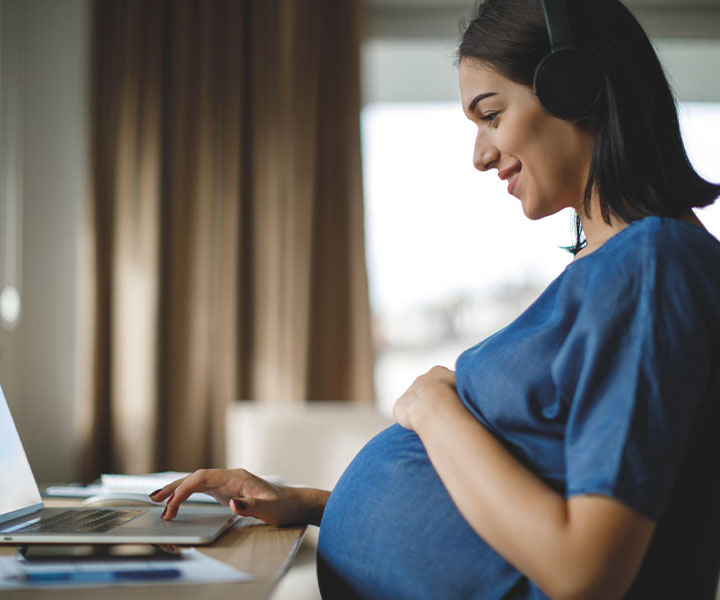
Expectant mothers also have the right to say no if they consider a task to be overly demanding.
It is important to understand that the pregnant employee’s subjective assessment is decisive and protected by law. Objective criteria, such as measurements of air quality or noise levels – for example, in a factory setting – are secondary in this regard.
Companies can leave a positive mark when dealing with pregnancy in the workplace
Given this framework, how much flexibility do employers and HR professionals have? First and foremost, the way they react to the announcement of a pregnancy is crucial. Their response sends a clear signal as to whether they view the pregnancy positively or negatively. This, in turn, significantly influences the employee’s attitude. Ideally, she feels acknowledged and supported, making her more motivated to remain at work for as long as possible.
Sometimes no major measures are needed. Something as simple as providing a reclining chair or adapting work schedules may be enough. Through conscious and proactive support, employers can also demonstrate that there is a consistent approach in place and that clear principles, rather than arbitrary decisions, guide the handling of pregnancy-related matters.
As case managers, we are generally called in when a company asks us to contact a pregnant employee. This often occurs after a sick leave notification, but a preventive approach is equally possible and, in my view, always worthwhile. It is usually a matter of facilitating communication between the parties involved. And this communication is by no means a one-way street with the employer merely on the receiving end. The employer is perfectly entitled to contribute to the discussion with medical professionals and, for example, to highlight measures that have been put in place to protect employees. This lends a more objective perspective to the question of whether a particular task is reasonable and whether sick leave is truly necessary.

The challenges of returning to work after giving birth
The next question is what happens after the employee returns to the workplace following childbirth. Unfortunately, we find that many women do not receive the support they actually need during this critical period. Particularly following a traumatic birth, specialised care is essential to prevent not only prolonged suffering but also substantial long-term costs. It is also worth noting that postpartum depression is by no means limited to women. Men, or partners, may also be affected and should acknowledge, both for themselves and for the other parent, how challenging childbirth and the first weeks with a newborn can be!
When new mothers return to work 14 weeks after giving birth, the topic of breastfeeding inevitably comes up. The law grants them 90 minutes of paid working time per day for breastfeeding or expressing milk. Nevertheless, we observe that while 62% of women are still breastfeeding in the sixth month after childbirth, this proportion drops to 24% once they return to work. In most cases, practical obstacles are the main reason. Employers can only benefit from removing these barriers, for example by providing a private room for breastfeeding or expressing milk and a separate refrigerator for storing milk.
This article originally appeared as part of the ‘Expert Tip’ series on bilanz.ch.
Further information:
Maternity protection for female employees (FR, DE, IT) – SECO